So welcome back to another blog post in my series of blog content around speech delay. This is a series that I started way back in February 2021, a few months after my son had started private speech therapy.
If I’m honest, I wasn’t sure we’d still be on this journey as we approach the end of Summer 2022 But we have made some really great progress. I’ve learned a lot and I’ve also really loved sharing with you, whether that’s on my blog or my Tik Tok or my Instagram, all about our speech delay journey with a toddler.
So I just wanted to make sure I created another update because I know they are so useful to people who are looking for examples and experiences of perhaps people who are a little bit further ahead in that journey. I scoured the internet when Jude first was diagnosed with speech delay to know what life would look like in a year’s time or even six months’ time.
So Jude is now three years and four months old-and we are still very much experiencing speech delay, but we’ve made some really great progress and we have learned a lot of different things from therapy.
Jude’s speech progress 18 months after starting therapy
I wanted to start with the progress that Jude has made since I last did an update post. So one of the hugest things is that the variety and the number of words he uses have massively increased. So when I last did an update we did have a lot of nouns and labeling things from like books and flashcards but now we have all types of different words. So we have names like Jude (he can actually say his full name with surname too!). We have verbs like up or carry or throw or push or blow etc. We also have some sort of concept words so things like ‘different’ or like ‘too hot.’ I’ve lost count of how many words Jude has now, which is a milestone in itself because when I was last during the blog post update, I was very much counting every single one of his words.
As well as that we are now finally at the stage where Jude is consistently joining two words together and occasionally three words sentences as well. To give you a timeframe, these developments really came on just in the last month or so since we broke up from the summer holidays. So since my last update, which I think was probably almost a year ago, Jude started to rapidly increase his vocabulary, however, still really struggled to put two words together. Even when we went past that 50-word mark, which lots of people had told us was sort of the milestone for them to quickly join words together. We realised that he had lots of nouns but didn’t have many verbs and subjects and names. So we’ve really worked on those things.
He seems to have finally understood now how to join the words together and seems to understand the idea of the subject and the verb like ‘Jude throw’ when before that was a bit difficult for him. And he seems to understand the idea now of putting like an adjective in front of nouns. So he will do a lot of things like ‘ blue ball’ or ‘one ball, two balls.’ He still doesn’t speak in proper sentences or full conversation but it’s still a big step.
As Jude has created more words, it became really obvious to us that he was struggling still with his speech sounds. Not sure if I covered this in the last update because we didn’t have loads of words then. But it became more apparent that do definitely has different pronunciation of lots of words compared to other kids his age. The main issues are he often misses the ends of words. So even words starting to sound relatively clear. might not actually be how you should pronounce them. So cat might be ca.

We’ve had to work really hard to get him to extend words because a lot of words might just be the first syllable. This is called final consonant deletion. And it’s actually pretty common up until they turn around three. However, Jude has other issues as well. He really struggles to make certain sounds like S and other signs he can say in isolation, but then gets really garbled when he’s trying to use them in words. Examples of these are G and C. And until very recently, F. This became more apparent and we were really lucky that we were able to start a therapy that specifically targeted this and phonics therapy, which I’ll talk about when I talk about the strategies a little bit later in the post.
@mumernity Speech therapy is a SLOW process but so worth it, so gfafeful we can afford to pay for it #speechdelay #speechdelayedtoddler #apraxia #toddlermum #ukmum #ukmumlife ♬ original sound – JennaFarmer-Honest motherhood
Jude’s tongue tie
This also meant that we did some more research and discovered that Jude has quite a severe posterior tongue tie, as well as other ties in his lips and cheeks. The tongue tie made so much sense because so much of speech is actually linked to things like feeding and because Jude has such a good appetite. We only started to realise as he got older that he wasn’t quite followed swallowing his food properly. He was still struggling with like reflux that he’d experienced when he was little. And he would also put too much food in his mouth and it would always be at the front of his mind like he couldn’t move it around his mouth properly. However, because he does have quite a good appetite he’d always worked around that and we didn’t realise it was a bigger problem until he got older, and we learned more about the tongue tie.
The tongue tie really made sense with some of his other issues as well such as the way that he sleeps, he sleeps with his mouth open and can often get disturbed in the night. He also struggled with other things like licking his lips and sticking his tongue out properly, which we thought was maybe to do with potential verbal dyspraxia, but now it sort of makes more sense that it’s to do with his tongue tie. So because of that, we developed a new stage of our speech therapy journey. We increased our private speech therapy to weekly and we also had a weekly myofunctional therapy session. Myofunctional therapy is basically everything to do with the mouth, the tongue, and those movements of the jaw.
@mumernity Little update from us-Jude has been diagnosed with stage 3 tongue and lip tie and something else I googled which apparently is a cheek tie… #speechdelay #speechdelayed #speechdelayedtoddler #apraxia #speechtherapy #toddlersoftiktok #ukmum #mumsoftiktok #ukmumsoftiktok ♬ Crazy – Patsy Cline
We have (finally) had a few 121 sessions with an NHS therapist and a block of 6 scheduled in September. About half of these sessions (So 20-30 mins a time) focus specifically on phonics and speech sounds. This has been the biggest jump that has really massively increased Jude’s speech and helped his accuracy so I’m so glad we pushed for that.
I think when I last wrote the update as well, we hadn’t explored other areas of communication as well. So we introduced an aided language display board probably about six months ago continually and this has massively helped as well. As soon as we introduced the boards, we realise just how many words Jude knew and wanted to use. It really helped him join words and symbols together as well and has massively helped his speech. It really does vary for every child.
Things that have helped on our speech delay journey.
Okay, so let me talk about the things that we’ve done this past few months that have helped.
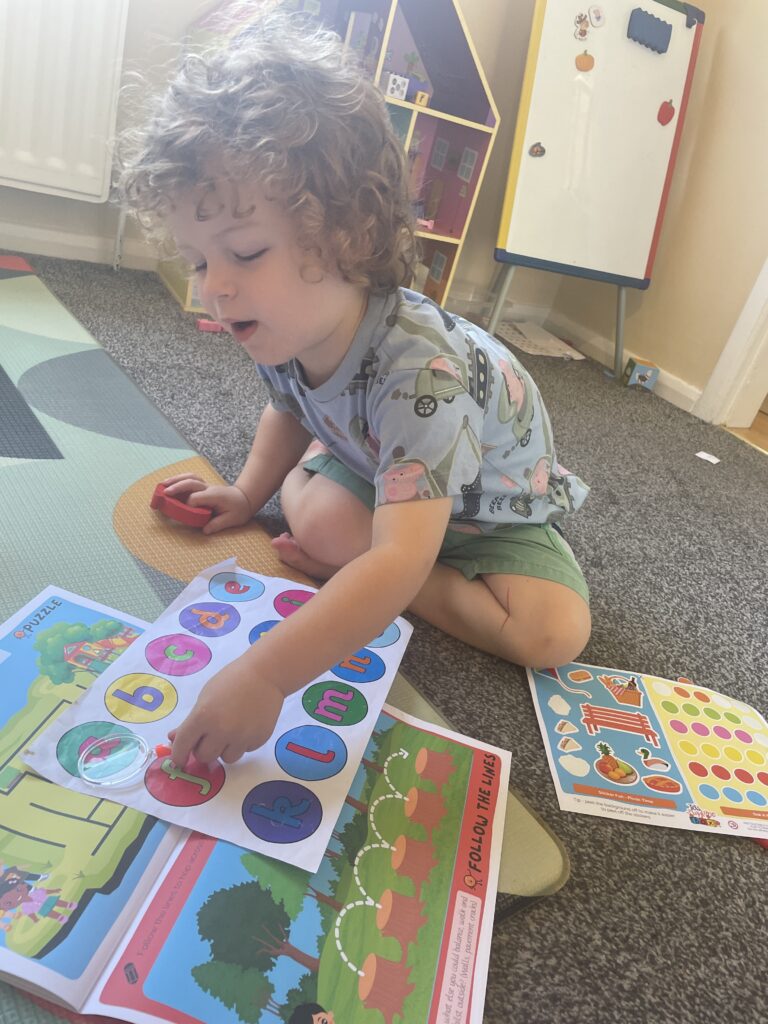
The first thing that we’ve really tried has been to focus on phonics and activities to help his pronunciation so I would really recommend the jolly phonics and alpha blocks resources we’ve done things like sticker books, flashcards, and magnets. Our therapist has played various games such as rolling a ball with letters stuck to it, attaching letters to animals etc-its all about exposing them to hearing (and then attempting) the sound as much as possible.
The Jolly phonics also has various printables (and an iPad app!) that our speech therapist has given us and we try to spend about 15 minutes each day focusing on phonic practice and individual speech sound practice (it does help that Jude loves the alphabet!) Another thing that we’ve really been doing that has helped us to be building up our aided language display. I can’t remember if I talked about this in the last update, but we have aided language display mats with hundreds of symbols and this has really helped Jude with his words. We use Widget Online https://widgitonline.com/. I would recommend starting with symbols that motivate-like biscuits and tv! We try to add symbols all the time based on his interest and what he’s trying to communicate. We notice it actually increased Jude’s speech when using it-not decreased it like we feared.
The thing we found really helpful was to focus on repeating lots of different two-word phrases that would be really useful for Jude’s day. to day life. And we also embedded the symbols for these in his aided language display mats as well. So examples are things like ‘build tower’ and ‘knock down’ because he really likes Lego. We also said ‘turn page# every single time we turned the page of a book and now he requests to do that himself. And because we knew he had a preference for things like numbers and colours, we use these to help build sentences. We’ve talked before about choices and how much choices have helped us so we change to using two word or three word choices instead.
@mumernity So excited to be able to share this now we’re consistently joining two words together-this stage has taken AGES! #speechdelay #toddlersoftiktok #speechdelayedtoddler #ukmumsoftiktok #ukmumsontiktok #speechtherapy #toddlermumlife ♬ original sound – JennaFarmer-Honest motherhood
So for example, do you want the blue brick or the yellow brick? do you want the red jelly or the chocolate biscuit? This really helps showed you that you can communicate with more than one word at a time.
We also gave him lots of space and pauses to try and courage that second word. At first, there seemed to be a huge gap between the first and second words. But as time has gone on, those two words are now much closer together and much more like little sentences in themselves. Now we know he can say more words, we really try to wait to encourage him to try to communicate (if we know he can) before giving him what he wants.
I have also updated my toddler toys and books for speech delay posts with lots of new suggestions of toys we love.
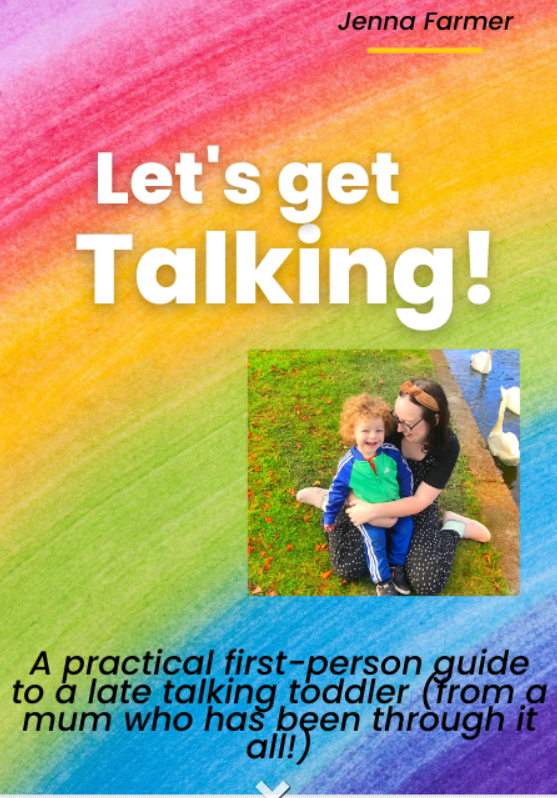
Finally, I have also written my own ebook on this very topic! (ad: linking to my own book) Let’s Get Talking: A Practical First-Person Guide to A Late Talking Toddler talks about our journey in much more detail and is crammed full of tips we’ve learned and implemented along the way of our speech delay journey.
That was a long post but I’m so proud at where we are now our-I hope the next update is even more positive. We still have a long way to go but I feel like I can now see there’s light at the end of the tunnel.