Words: Keisha Ehigie, founder of Imagine Me Stories. Come back tomorrow where we’ll be giving away a subscription!
Like so many others, the death of George Floyd and the subsequent protests around racial inequality has led to a painful period of reflection for me. Partly around the hurts that have occurred and are unfortunately still occurring, but also a deeper reflection on what can be done to prevent the negative aspects of history being repeated.
As a Nigerian- Jamaican mother, I know too well the harmful effects that non-diverse libraries can have on children. My daughter was only three years old when she told me she wanted to be ‘pink’.
It was a wake-up call for me as prior to that I hadn’t given much thought to the ethnicity of the characters in the books we selected. I suddenly realised that in our vast library the only children’s book that could be considered representative was a copy of Handa’s Surprise that my mother had bought her for Christmas.
Every other book either featured a white main character or an animal. Similarly, the children’s programmes we watched and the dolls we owned or were gifted, were all distinctly different from our reality and my three year old daughter had noticed that even if I hadn’t. It also occurred to me that as much as BAME children like my daughter were feeling the impact of not being represented in the world around them, children from white families were also being denied the opportunity to learn about experiences different from their own.
Statistics released by CLPE show that out of all the children’s books published in the UK in 2018, only 4% contained a BAME main character, in contrast to the 33.1% of BAME children in UK schools. This shocking statistic led me to start Imagine Me Stories, a subscription box that provides books with black main characters and African/black history activities to help to inspire, educate and promote discussion.

So how can you diversify your child’s library? Maybe you have looked at your library and realised with a shock that the books in them are not as diverse as you would like them to be. You may have gone online and felt overwhelmed by long lists of suggested books and websites. Where do you start? My suggestion is to explore these six simple steps. This is a journey, and hopefully it can be a fun one too!
1.Start small and show similarities
As tempting as it can be, resist the urge to immediately overload your child with a shedload of diverse books. They probably already have a selection of favourite books and that’s fine.
Try to keep it as fun and as natural as possible, so that it doesn’t feel forced. Start off by introducing a diverse book that plays to your child’s current interests, and where the protagonist’s background is not a main feature of the story. For instance, does your child like to swim? You could get Jabari Jumps by Gaia Cornwall, a book about a black boy who works to overcome his fear of diving while swimming with his dad.
Is your child a stargazer? Try Look Up, by Nathan Bryon about a little black girl who loves stars. In both of these books, the ethnic background of the main character is incidental and is not the main feature of the storyline. Gradually work to include books like this to show your child that while children come from all sorts of different experiences and backgrounds, ultimately, they still enjoy doing the same things.

Sources: Book Trust is a good place to search for books which are categorised into different strands such as BAME, disability, immigration, interests, age etc
2.Travel through a book!
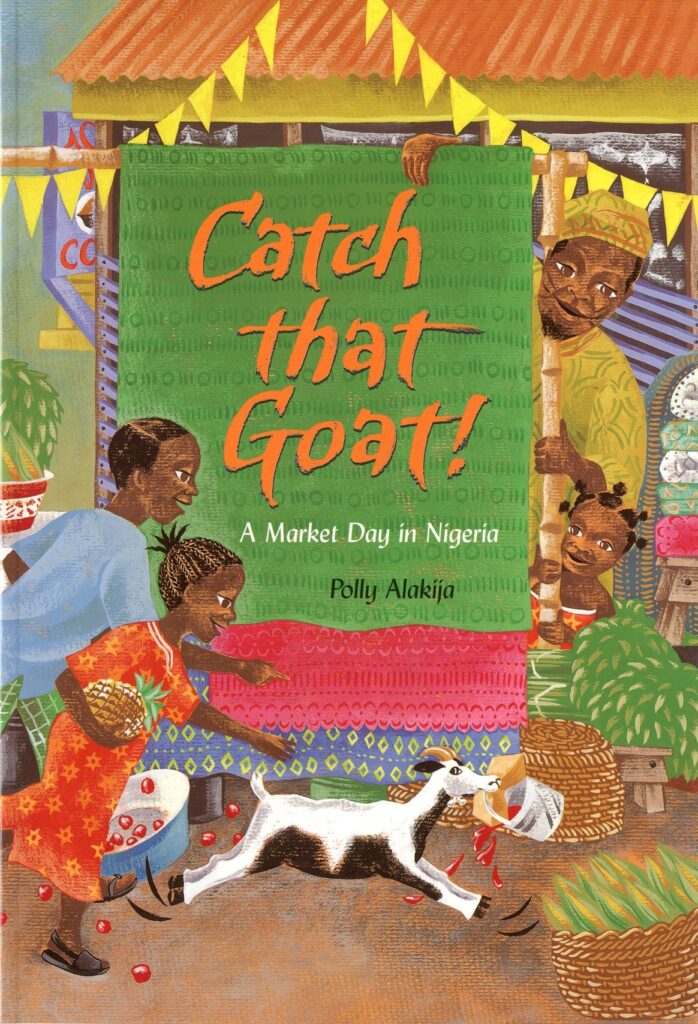
Books can be a wonderful way to experience different cultures, names, foods and languages minus the expensive ticket fare. One of our favourite cultural books is Catch that Goat, about a girl from a small town in Nigeria who is left to look after a very naughty goat. The goat runs riot through a local market stealing items from the traders and the reader is encouraged to count the items that are left all while looking out for the troublesome goat. Books like this are a good way to learn about names, greetings and community values that are different from what your child may have been exposed to, without reinforcing negative stereotypes. Sources: Catch that Goat was published by Barefoot Books and they have a whole range of books that explore different cultures.
3.Be brave, explore differences
Challenge yourself to get a book that you may have previously looked at and thought is ‘not for …(insert child’s name)’. A key part of diversifying your library is unlearning your own unconscious assumptions about what books may be suitable or interesting. You may be unwittingly passing those thoughts down to your child.
For example, buy a book where the protagonist explores their afro hair (there are loads! Hair, it’s a family affair by Mylo Freeman is a good start). Or a book where the main character has a disability if that’s not your child’s reality, like Cyborg Cat by Ade Adepitan where the protagonist’s disability becomes his superpower. While it may not be directly relevant to your child’s experience, by reading it together you get to see life through a perspective you may not have previously been conscious of or aware of which is a critical tool to teach your child about empathy.
4. Relearn history
Current events have shown that many historical achievements have been taught to favour a Eurocentric view. How many BAME inventors do you know? Does your library reinforce the stereotype that only white people are capable of achieving great things? Sources: Books such as the Little Leaders series by Vashti Harrison, Little People Big Dreams series by Maria Isabel Sanchez Vegara, and Young, Gifted and Black by Jamia Wilson are a good starting point to show your child that greatness comes in all shapes and colours.
5.Have honest discussions
Studies show that children become aware of race from as young as 3 (that was certainly the case for my daughter) so avoiding discussions around race can definitely do more harm than good.
While we may think that racism is something only ‘mean people’ do, the reality is that while a lot of people don’t have harmful intentions, they’re still making judgments based on race. Try to buy a book that directly addresses the issue of race and the harmful effects of racial prejudices in order to have open and honest discussions.
A good starting point is Amazing Grace by Mary Hoffman. It addresses both gender and racial biases in a simple way that children can understand. Grace is a black girl who wants to play the part of Peter Pan in her school play but some students in her class don’t think she is suitable because of her ethnicity and gender. This could promote a discussion on why we think some people are more suitable for certain things than others and lead to discussions on other forms of bias such as age, sexuality, religion etc.
6. Lead by example
This is simple but very important. There’s no point working on your child’s library if you’re not also working on your own. Children learn best by watching others, how many diverse titles do you own?
Promoting diversity is a journey, but with a little bit of determination and a positive outlook, it can be a fun and educational experience for you and your child.
Keisha Ehigie
One comment