If you follow me on Tiktok, you’ll know how passionate I am about rising childcare fees, the juggle and why we just don’t do anywhere near enough to prioritise and support working mums in our country.
Someone who is leading the path for change in this area is Anna Whitehouse, aka mother pukka: a journalist who has hugely campaigned for more flexible working with her influential Flex Appeal Campaign.
Anna Whitehouse (@mother_pukka) is working with Haliborange on its #HappyHabits campaign. As a massive fan of her work, I was thrilled to chat to Anna over email about all my favourite mum topics: working mum guilt, the impossible juggle, and mum shaming that appears to still be so common.
You are of course an amazing advocate of flexible working for parents-now the pandemic is over, do you feel that more employers are understanding, or do we have a lot of work to do?
I think the pandemic demolished the nine to five as we know it. If companies didn’t Zoom in or log on, ultimately, they would have had to shut down. What we’re seeing now is a really binary discussion over working from home versus working in the office. The nuance of this discussion is core hours and job shares. All of this specifically impacts mothers. Pre-pandemic 54,000 mothers every single year were pushed out of the workforce for simply having a baby. Do I think those figures have changed? I don’t know. Do I think the current working world is helping support those women? I don’t think it’s that different, but I do think we’re moving towards a slightly more flexible world.
I hope we stop talking about flexible working and actually just talk about inclusive working, because why would you not want to include the best talent at your table? I think that’s where we’re shifting. Companies are seeing it as a talent discussion, instead of where someone is sitting/working.
“Pre-pandemic 54,000 mothers every single year were pushed out of the workforce for simply having a baby”.
2. What advice do you have for parents who are trying to speak to their employer about flexible working-how can they ensure the conversation is a success?
It’s really tough because maternity discrimination is still rife, and gender pay gap reporting was scrapped during the pandemic. So, I have to be really straight that the odds are still stacked against women. There is no way that I can bypass that. You have to recognise that there are still archaic, dinosaur employers who think “if I can’t see you five days a week strapped to your desk – you’re not working.” What I would suggest would be to get the support of “Working Families” if you think it’s a legal issue, and if you have been discriminated against and you think it’s a specific maternity legal case, call Pregnant then Screwed.
If it is that in-between where you need a hint of flexibility and you’ve got a slightly curmudgeonly begrudging employer – set out your business case! Remove emotion, remove your human need, this is about you doing the best possible job that you can. Set out your business case and then suggest a trial period and how you’re going to measure it. Because we are still in that period of transition. I wish I could just say go in there, all guns blazing, “this is how I would like it to be” but for a lot of employers, that’s still not going to be accepted. But I think you can meet in the middle with a robust business case with that trial period, measure it and then knock it out of the park. Then they have no way of refusing it. So hopefully, when your kids have grown up, it won’t be like this. But for now, I think this is going to bridge the gap.
3. How do you juggle work and life balance as a mother?
I don’t think the words “juggle” and “balance” are in my dictionary as a parent. I don’t know anybody who could effectively say they’ve achieved both of those things. I think it’s more sellotaping over the cracks, and they’re cracks that aren’t really created by me or my family but feel more societal; the cost of childcare, the flexibility of our workplace, they’re the cracks that I feel like we as parents are sellotaping over. So, I never really put it on my shoulders.
I think I stopped saying “I’m sorry”, a long time ago when I realised actually it’s not my fault. And so I don’t answer the question, how do I juggle or balance things? Because actually, it’s hard for everyone. And I don’t know anyone that can, but it’s not your fault, and it’s not my fault. So, I don’t have those benchmarks anymore. Just getting through the day is the way forward.
“I think I stopped saying ‘I’m sorry’ a long time ago when I realised actually it’s not my fault.”
A morning routine is key for us as a family; you have to start the day, the right way. When I was younger, my mum used to get me and my sister to make our beds and that gave us a sense of ownership of our space. We love to start the morning by dancing around to Taylor Swift – we do a little kitchen disco and just Shake It Off… that helps to start the day off on the right foot.
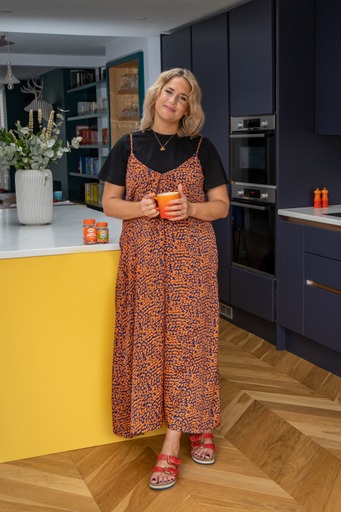
We always take our Haliborange kid’s and adults’ vitamins together in the morning, one for them and one for me. Then other daily habits for us are just making sure we repackage things like mealtimes or any of those other slightly banal moments and embracing them as moments where we can cuddle up, snuggle up and lean in.
Haliborange’s #HappyHabits campaign celebrates the unique habits we all have as a family that make us happy. It really hit me because as a parent, you’re constantly in a cycle of habits/routines – bedtime, bathtime, mealtime. You know it’s good for them and its good for you, but sometimes in that cycle you lose the joy, the happiness. But actually, a lot of that routine for us is fun-filled. They’re moments we have together as a family.
4. You spoke recently about separation anxiety when your child goes to nursery-how do you deal with the guilt many of us mums feel about leaving their child for work? (Even though it’s completely necessary)
I never use the word guilt because I don’t think anyone should feel guilty about providing for their family. No woman should feel, as no man should feel, guilty about holding on to the thing that lights up their soul. You don’t suddenly become a parent and remove yourself – that’s not good parenting, either.
Showing your child that you essentially dissolve as soon as they land isn’t a great message. So, for me, it’s not saying guilt, it’s about communication. Stop seeing them as children and actually speak to them on a level playing field and say, “Mummy’s got to work today and this is what I have to do: X, Y, or Z”. I’ve found that this has opened up conversations with my children about my work, and they fully understand where I go. I show them photos of my office and my studio and I paint the picture for them. I tell them the story of how I got there, how it was really hard at times and how I sometimes didn’t get the interviews I wanted to, but I didn’t give up.
Every career choice you make, whether it is to stay at home with your children, or to work away, is a story and it’s an educational story for your children. Don’t minimise that for them and don’t baby them. Because ultimately, why would your children not want to know more about where their mum is? That has completely dissolved the separation anxiety between us because I obviously know where they are, that they’re safe, they’re cared for, and now they know where I am. I’m sort of flexing another muscle that matters to me. I think that bridges that gap. It doesn’t remove it completely. But it’s not guilt. It’s really ownership of what matters to you, too. Alongside your children.
How do you cope with the childcare juggle-especially with rising fees (which we’ve talked about before) and then summer holidays? How do you make it work?
@mumernity Replying to @freakyfriday2793 heres why most countries properly subsidise childcare #honestmotherhood #motherhoodunfiltered #ukmum #ukmumlife #mumstogether #mumlifeontiktok #ukmumsontiktok ♬ original sound – JennaFarmer-Honest motherhood
I don’t. And I think that’s why we continue to campaign. It’s a broken system, we have the second highest childcare costs in Europe. That’s not to be too negative, it’s just if you don’t state the reality, you can’t fix the problem. I don’t make it work. My husband and I, have I think the word is “cobbled together” childcare like many other parents forever. What we’re doing now is putting energy towards trying to move the UK system towards more of a Scandinavian model where childcare costs are capped so that women aren’t left behind in the way that they are in the UK. Ultimately at the moment, what we’re seeing is women logging off from careers because they can’t afford to pay childcare, which isn’t helping the economy.
“My husband and I, have I think the word is “cobbled together” childcare like many other parents forever.“
Thank you so much for your post on a C-Section is birth! What other mum taboos/judgments have you faced when being a mum?
I think there’s a big taboo around the word “full-time mum”. I think that’s a really important phrase to deconstruct because whether you work or whether you are at home, no parent I know is at home. You are looking after children you’re out and about all the time. So I think it’s important to reiterate that every mother is a full-time mother. No one is lesser for the choices they made. They’re individual choices. But we are all full-time parents, regardless of how much of that working week you are with your child because they are never far from your mind. There’s always a little white noise in the background of thinking, have I done this? Have they had their jabs? What do they want for tea? I wonder if they’re okay, “God, she really didn’t go to school okay, this morning” … You are always full-time parenting, whether you stay at home or work away.
Anna Whitehouse (@mother_pukka) is working with Haliborange on its #HappyHabits campaign that is celebrating all the family habits we do that makes us happy. Visit the @haliborangeuk Instagram account to find out more and share your own happy habits.